
 How to Choose the Right Pergola Company (and What It Costs)
A pergola is a real construction project, not a weekend add-on. The best ones turn a patio into a year-round space you actually use. The worst ones become a source of leaks, permit headaches, and regret. The difference almost always comes down to who builds it — and knowing what you should be paying. If you’re researching companies, maybe after an experience that didn’t go the way you hoped, here’s what separates a pergola you’ll love from one you’ll fight with.
Know what kind of pergola you actually want
“Pergola” covers a lot of ground. A simple shade structure is one thing. A modern bioclimatic pergola — with a motorized louvered roof that opens and closes, integrated lighting, heating, and optional glass or vinyl walls — is a different level of build entirely. The second kind is effectively an outdoor room, and it needs to be engineered, wired, and installed like one.
Get clear on whether you want basic shade or a fully functional, all-season space. It changes everything about who’s qualified to build it — and what it costs.
What a pergola actually costs
Pricing swings widely by material, size, and features. Here’s where the 2026 market sits so you can budget realistically:
- A manually adjustable louvered pergola runs roughly $45 to $110 per square foot installed.
- A motorized louvered pergola runs roughly $155 to $225 per square foot installed.
- A smart, sensor-automated system runs roughly $75 to $175 per square foot installed.
In whole-project terms, most residential installed louvered systems land between about $45,000 and $85,000 or more, depending on size, features, and site conditions. Larger custom bioclimatic systems with electrical, screens, and solid roofing reach $50,000 and up.
A few things that move the number:
- Size drives cost more than any other single factor — bigger structures need stronger columns, deeper footings, and more labor.
- Motorization and smart controls add electrical, automation, and installation complexity.
- Electrical work — lighting, heaters, and motor circuits — is a real line item. Outdoor lighting runs roughly $80 to $300 per fixture, and adding an outdoor outlet runs about $180 to $350 each.
- Site prep and region matter — local labor and site prep can add 10–25% to base figures.
Treat any “average” as a starting point. No two pergolas share the same design, site, or feature set, so the only number that really means anything is a quote based on your actual space.
Ask about engineering and permits up front
 This is where a lot of projects go sideways. A quality pergola, especially a louvered or enclosed system, needs proper structural engineering and, in most areas, permits and inspections. Ask any company directly:
- Will this be engineered and stamped for my location’s wind and snow loads?
- Who pulls the permits, and who coordinates inspections?
- How do the columns attach to the foundation, and is that detail engineered?
If the answers are vague, that’s your signal. Cutting corners on engineering is what leads to sagging roofs, failed inspections, and structures that don’t hold up in real weather.
Look for specialists, not generalists
A general contractor who builds pergolas occasionally is not the same as a company that installs them week in and week out. Specialists know the systems, the hardware, the failure points, and the field conditions that come up once you start digging. They’ve solved the problems your project will hit before you’ve hit them.
Ask how many pergolas they’ve installed, whether they handle the full scope — foundation coordination, structure, electrical, motorization — and whether they can show you completed work.
What a good process looks like
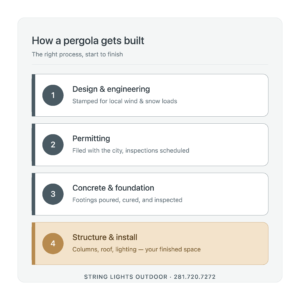
A well-run pergola project moves in a clear order: design and engineering, permitting, foundation and concrete, then structure and installation. Each stage gets inspected and signed off before the next begins. You should always know what phase you’re in and what’s next. If a company can walk you through that sequence confidently on the first call, that tells you a lot.
Pay attention to how they handle the hard parts
Every real project hits a surprise: an existing footing underground, a column that needs to shift a couple of inches, a drainage question. What matters is how a company handles it. Do they stop and get an engineer’s determination in writing, or do they wing it? Do they keep you informed, or do you find out later? A company that documents decisions and communicates clearly is one that respects your investment.
Why homeowners and operators are switching to specialists
More and more people reach out to us specifically because a previous pergola experience left them frustrated — and they’ve done their homework to find a specialist this time. That’s the right instinct. The companies worth hiring are the ones who treat a pergola as the engineered structure it is, communicate every step, and stand behind the work.
Talk to us
At String Lights Outdoor, pergolas are what we do. We handle bioclimatic and louvered systems, commercial and residential, from engineering and permitting through installation — and we’re happy to walk you through the whole process, and give you a real number for your space, before you commit to anything.
Call us at 281.720.7272 or reach out through our site to talk about your project. Whether you’re just starting to research or recovering from a project that didn’t go as planned, we’ll give you a straight answer about what’s possible.